Brand
Inside the Design Room: What Actually Happens When a Branding Agency Builds Your Identity
From the first brief to the final brand guide: the six-stage process that separates agencies that last from agencies that template.
MalbarDesign creates original, strategic logos for businesses that take their brand seriously.
From the first brief to the final brand guide: the six-stage process that separates agencies that last from agencies that template.
The Brief Is Not the Beginning
A persistent fantasy surrounds how brand identity gets made: the client sends a brief, the designer opens Illustrator, a logo appears. That is roughly as accurate as assuming surgery begins when the scalpel touches skin. The real work lives in what happens before and between those moments. Understanding it is the difference between a business that gets a visual identity and a business that gets a brand.
The brand identity market has never been more crowded with options than it is in 2026. AI platforms generate logos in minutes. Freelance marketplaces offer $50 designs with 30 concepts. Design subscription services promise unlimited output for $499/month. Yet the companies that come out of those pipelines frequently return 18 months later, looking for what they actually needed the first time: a designed identity that works strategically as well as aesthetically.
“Brand identity work, at its best, creates something that doesn’t yet exist: a visual and verbal expression that is specific to a particular organization’s character, honest about its culture, and genuinely distinctive in a crowded market.”
Human Agency, 2026
Stage 1, Discovery: Learning to See Your Business as Your Audience Does
Professional discovery goes well beyond a questionnaire; it is a structured diagnostic. At MalbarDesign, the first conversation with a new client is explicitly diagnostic. There is no pitch and no portfolio walkthrough, just listening. What are you trying to build? Who are you trying to convince? What does your best current customer believe about you that you wish all of your prospects believed?
Discovery output includes a competitive landscape map, an audience perception audit, and a positioning hypothesis that the design work will then be asked to express. This stage typically runs 3–5 business days for a new identity project, and it is what most cheap alternatives skip entirely.
Stage 2, Strategy: Deciding What the Identity Must Do
A logo that could belong to any of your competitors is, strategically, worthless. The strategy stage answers a set of uncomfortable questions. What visual language does your category default to, and should you conform or break from it? What emotion must the first impression trigger? What must the identity still communicate at 16px, monochrome, embroidered on a jacket?
Brand strategy in 2026 increasingly takes motion-first environments into account. According to The Branding Journal’s 2026 trend analysis, logos and visual systems are moving away from fixed and rigid forms; they must adapt, move and respond to different screens and contexts. A strategy that doesn’t account for digital-native deployment is incomplete.
Stage 3, Concept Development: Where Design Actually Happens
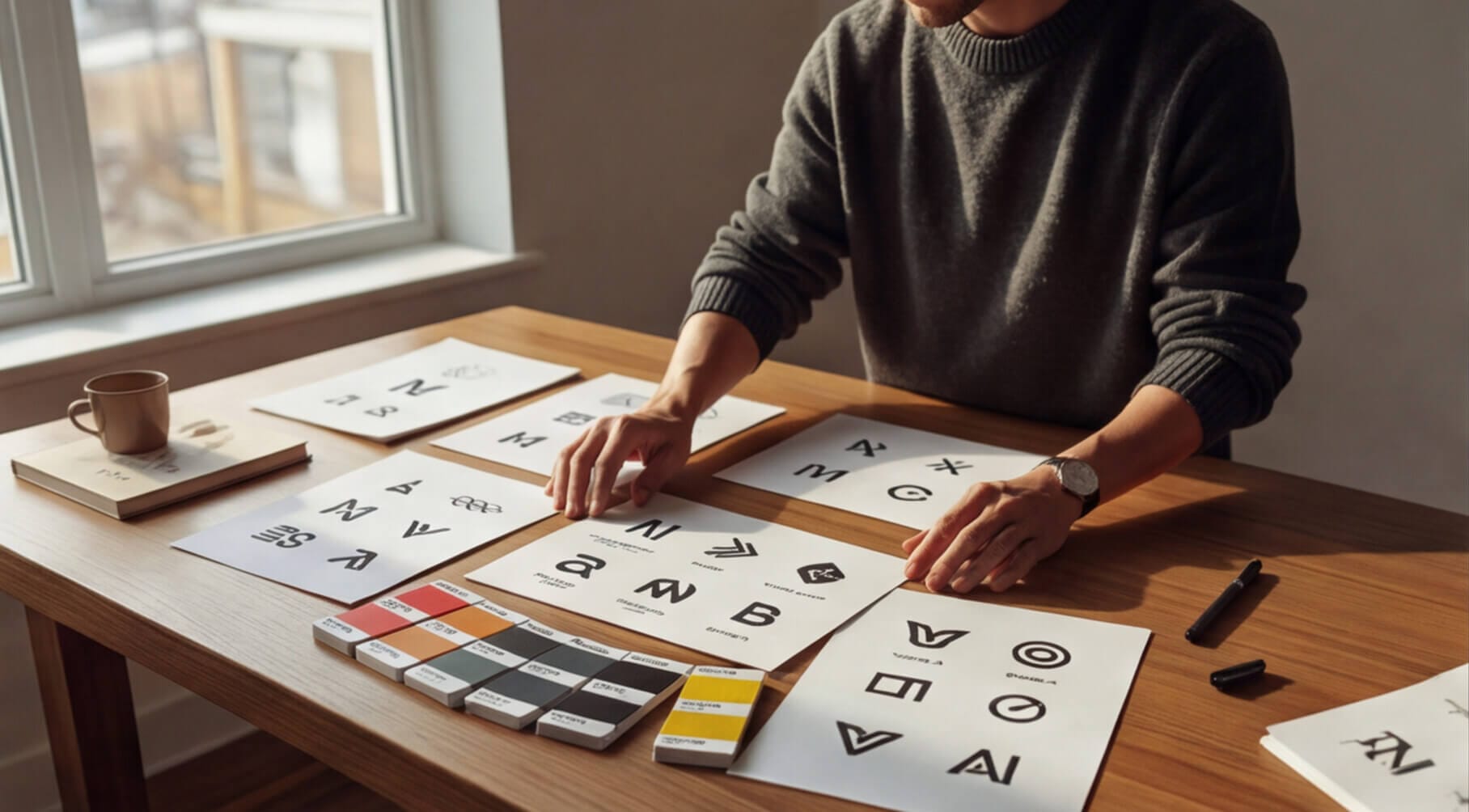
This is the stage clients imagine when they think “design,” and it typically takes 20–40% of the total project time. Designers explore multiple strategic directions (rather than multiple aesthetic styles) before presenting a curated shortlist. At professional agencies, the concepts presented are only some of the concepts explored. Experienced designers ruthlessly self-edit against the strategy brief before a client ever sees the work.
Common deliverable: 2–3 concept directions, each with a rationale explaining what strategic problem it solves and why the visual choices serve that solution.
Stage 4, Refinement: The Detail Work Most Clients Don’t See
Once a direction is selected, refinement begins. It includes optical corrections (logos are balanced visually rather than mechanically, which requires deliberate adjustment), color system development, typography pairing and safe-zone specifications. A well-refined logo may go through 40–80 micro-revisions that the client never sees, all in service of a mark that feels inevitable.
Stage 5, Application Testing: Proving It Works in the Real World
A logo that looks perfect in Illustrator can fail catastrophically in deployment. Professional agencies test an identity across real environments before delivery: business card mockups, website header, social media profile crops, signage scale, merchandise application. Failures caught here stay invisible to the client. Failures caught after launch are expensive and public.
Stage 6, Brand Guide Delivery: The Asset That Protects the Investment
The brand guide is the mechanism that makes the identity durable. It specifies exact color values (RGB, CMYK, HEX, Pantone), typography hierarchies, logo clear space and misuse rules, photography and illustration style guidance, and approved application examples. Without a brand guide, even a brilliant identity erodes within 12 months as team members make their own interpretation decisions.
Companies with well-documented brand guides report recognition rates 79.8% faster than brands using inconsistent visual applications, according to a 2026 visual cognition study cited by Amra & Elma’s brand consistency research.
FAQ
Q: How long does a full brand identity project take?
A: A focused logo and brand identity project at a boutique agency typically runs 2–4 weeks. Full rebranding including strategy, naming review, and comprehensive brand guide delivery runs 6–12 weeks.
Q: What’s included in a brand guide?
A: A professional brand guide covers logo usage rules, color palettes with all technical values, approved typography, spacing and safe-zone specifications, photography/illustration style, and common application examples (digital and print).
Q: How many logo concepts will I see?
A: Professional agencies typically present 2–3 strategically distinct directions rather than a volume of options. More isn’t better: a curated selection backed by rationale leads to better decisions and better outcomes.
Q: Can I provide my own creative direction?
A: Yes, and a good agency will interrogate it. Client direction is valuable input, but the designer’s job is to challenge direction that conflicts with strategic objectives, not simply execute instructions.
Q: What file formats will I receive?
A: A professional delivery package includes: AI/EPS vector source files, SVG, PNG (transparent background, multiple sizes), and PDF. Dark, light, and monochrome variants are standard in a complete delivery.
Sources
FAQ
Questions people ask
How long does a full brand identity project take?
A focused logo and brand identity project at a boutique agency typically runs 2–4 weeks. Full rebranding including strategy and comprehensive brand guide delivery runs 6–12 weeks.
What file formats will I receive from a professional logo designer?
A professional delivery package includes: AI/EPS vector source files, SVG, PNG (transparent background, multiple sizes), and PDF. Dark, light, and monochrome variants are standard.
Not sure whether your brand needs a refresh or a rebuild?
Ask for the free 5-point brand check: concrete recommendations for your logo and website within 48 hours, no sales call unless you want one.
Related articles
All articles Brand
BrandQuiet Confidence or Dopamine Design? 2026 Trend Test
2026’s web trends split in two: neon dopamine design and quiet, grain-textured restraint. Which fits your brand depends on the decision your buyer is making
· 5 min read
 Brand
BrandHow to Launch a Rebrand Without Losing Your Customers
The files are delivered, and now comes the part that decides everything: the switch. The 215-asset inventory, the bridge period, the inside-out sequence, and the 30-day scoreboard.
· 4 min read
 Brand
BrandWhy 2 Logo Directions Beat 10 Concepts, Every Time
“How many concepts do I get?” is the most revealing question in logo design. Why high concept counts signal uncertainty, and what a decision-led process looks like
· 4 min read