Brand
Logo Design Brief: How to Write One That Works
A weak logo design brief guarantees a weak logo. Here’s the exact brief structure pros use: 12 questions, real examples and a free template to steal.
**Looking for a professional logo designer?**
MalbarDesign creates original, strategic logos for businesses that take their brand seriously.
A logo design brief is the cheapest insurance you’ll ever buy for your brand, and the document most founders skip entirely. After fifteen years of designing identities, we can predict how a project will end by page one of the brief. Sometimes by line one. “We want something modern and clean” has preceded every difficult project we remember. Twelve precise answers have preceded every smooth one.
When a logo project goes sideways, it almost never derails in the design phase. It derails weeks earlier, in a brief that was never really written. The revision rounds that eat your budget are just the invoice for that skipped homework, arriving late.
Below is the exact brief structure we use with clients at MalbarDesign, the twelve questions behind it, and a template you can copy at the end. Use it even if you never hire us.
Why Most Logo Projects Fail Before the First Sketch
A client came to us after two failed attempts with other designers. Both previous projects had collapsed the same way: concepts delivered, feedback of “not quite us,” more concepts, more vagueness, mutual exhaustion, refund negotiations.
We asked to see the briefs. There weren’t any, only emails. In one, the entire creative direction read: “Professional but friendly, premium but accessible.”
That sentence describes every brand on Earth and therefore none. The designers weren’t bad at design. They were being asked to read minds, and billing for each failed guess. Once we spent ninety minutes building a real brief, the project that had failed twice finished in three weeks with one revision round.
The math is simple: an hour spent on the brief replaces a week spent on revisions. And since revision rounds are where logo budgets actually overrun, a sharp brief is also the best price negotiation tool you have.
What a Logo Design Brief Actually Is (and Isn’t)
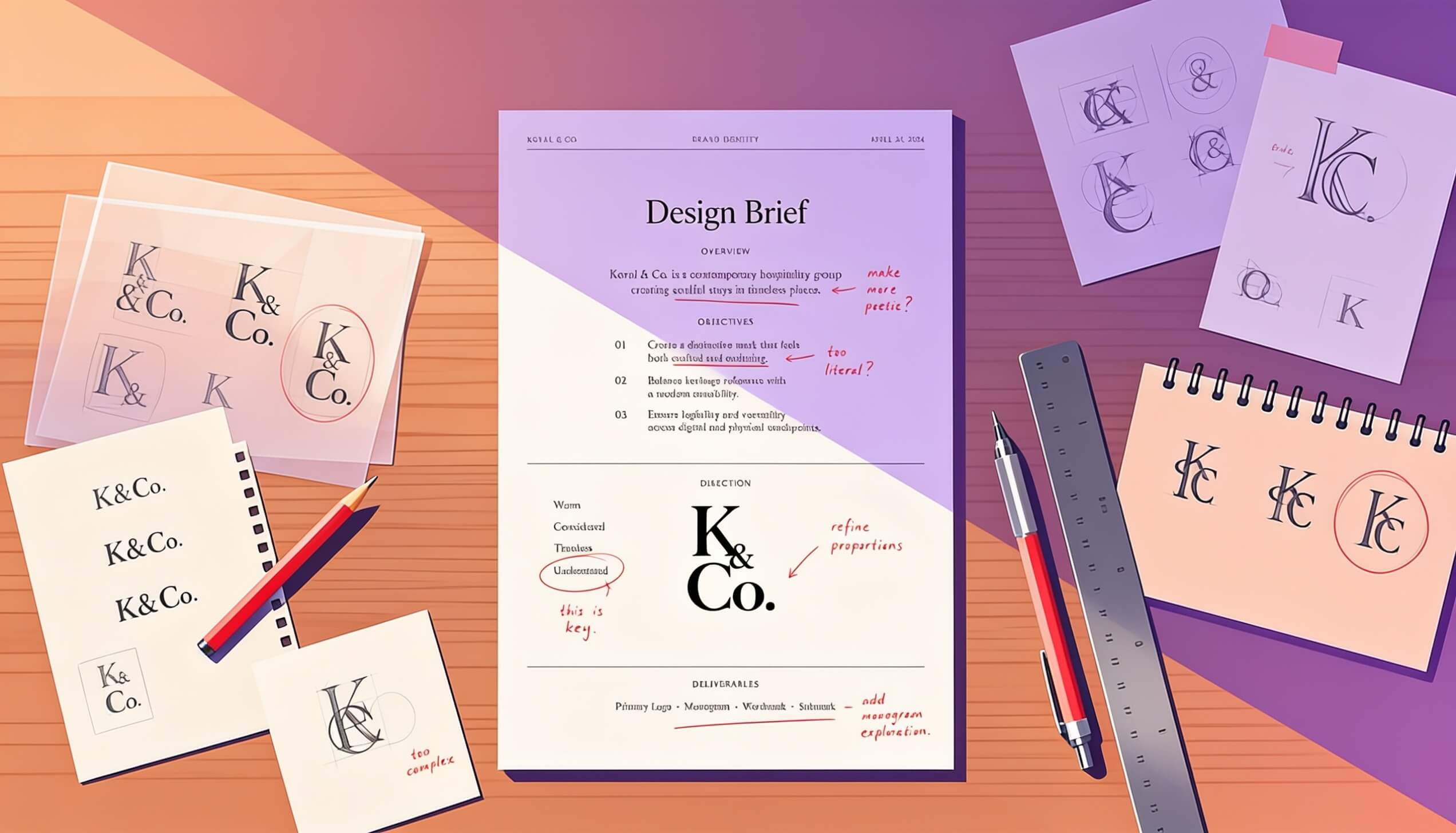
A logo design brief is a one-to-two-page document answering three things: who you are, who must care, and what the logo has to do in the real world. Nothing more. It is the shared map both sides navigate by when opinions collide, and opinions always collide.
What it isn’t:
- It isn’t a design instruction. “Use blue, put a lion in it” is a pre-made decision wearing a brief’s clothes. You’re hiring judgment, so brief the problem and leave the solution to the designer.
- It isn’t a mood board. References belong in a brief, but only with notes on why each one resonates. Ten Pinterest images without commentary tell a designer nothing except that you have Pinterest.
- It isn’t homework only you do. The best briefs are finished together: you supply raw answers, and the designer interrogates them during discovery. If a studio never asks to refine your brief, that tells you something; it’s question #3 in our guide on how to choose a branding agency.
The 12 Questions Every Logo Design Brief Must Answer
Business & audience
1. What do you do, in one sentence a stranger understands? Skip the mission statement. Write the sentence you’d say at a barbecue. If this takes you three attempts, that struggle is useful data, so write down attempt three.
2. Who exactly must this logo work on? “Everyone” is the most expensive word in branding. Describe your three most profitable customers as real people: where they see your brand, on what device, in what mood.
3. Who are your three closest competitors, and what do their logos get right? A logo’s first job is differentiation. Your designer needs the visual landscape you’re entering, including what’s already taken. (This also prevents the awkward moment of receiving a concept that looks like your rival’s.)
4. What should someone feel in the first two seconds? Pick three adjectives, then (and this is the important part) pick three you explicitly reject. “Premium but not cold. Friendly but not childish.” The rejections do more steering than the choices.
Style & references
5. Which existing logos do you admire, and why precisely? Two or three examples, each with one sentence on what works for you: the simplicity, the color, the mood. The why matters more than the what.
6. Which logos do you dislike, and why? Anti-references prevent entire categories of wasted concepts. One client’s “nothing with swooshes, our industry drowns in them” saved us a full revision round.
7. Is there anything from your current identity worth keeping? Existing brand equity is real money. If your customers recognize a color or symbol after years of exposure, a full rebrand may destroy value a refresh would keep.
Practical constraints
8. Where will this logo actually live? List your real touchpoints: website header, app icon, vehicle wrap, embroidered polos, invoice. Embroidery alone kills fine gradients; a 16-pixel favicon kills detailed emblems. Context decides which of the seven logo types can even work.
9. What deliverables and formats do you need? Vector masters, color variants, dark/light versions, social avatars, favicon: agree on the package upfront. (If formats are foreign territory, here’s which logo file does what.)
10. What’s the timeline, and what’s driving it? “ASAP” produces rushed work. A real date with a real reason (trade fair, launch, funding round) produces prioritized work. Designers plan differently when they know what the deadline protects.
11. What’s the budget bracket? Founders hide this number, fearing it will be spent to the ceiling. In practice, the bracket determines scope: €800 buys a different process than €5,000. Hiding it just means discovering the mismatch later, expensively.
12. Who has final approval, by name? This is the silent project killer. If a co-founder, spouse or investor can veto the result, they belong in the brief and ideally in the kickoff call. Surprise stakeholders in round three have buried more good logos than bad taste ever has.
Logo Design Brief Example: Before vs. After
Before (real, anonymized):
“We’re a modern logistics company. We want a logo that’s professional, fresh, stands out, works everywhere. Blue maybe? Open to ideas.”
Twenty-six words, zero decisions made, infinite concepts possible, and infinite revision rounds likely.
After (the same client, post-discovery):
“We move pharmaceutical freight across the EU; our buyers are compliance managers who choose us because we’re boring and certified; trustworthy beats exciting. Feel: precise, calm, institutional. Reject: playful, startup-y, swooshes (industry cliché). Competitors X and Y both use dark blue + globe icons; we want distance from globes. Logo must survive: vehicle livery at 50 m, 16 px favicon, single-color customs stamps. Wordmark or lettermark preferred. Final sign-off: both founders, jointly, one call. Deadline: 1 Oct, trade fair in Hamburg. Bracket: €2,500–3,500.”
Ninety words. The project practically designs itself, and the first concepts will already be eliminating between good options instead of guessing at the universe.
Free Logo Design Brief Template
Copy, fill, send. One page is enough.
LOGO DESIGN BRIEF: [Company name], [date]

1. WHAT WE DO (one plain sentence):
2. OUR 3 KEY CUSTOMERS (who, where they meet our brand, on what device):
3. TOP 3 COMPETITORS + what their logos get right:
4. FEEL: 3 adjectives we want / 3 we reject:
5. LOGOS WE ADMIRE (2–3 + why, one sentence each):
6. LOGOS WE DISLIKE (+ why):
7. WORTH KEEPING from current identity (colors, symbols, equity):
8. WHERE THE LOGO MUST WORK (all real touchpoints, smallest size):
9. DELIVERABLES NEEDED (files, variants, formats):
10. DEADLINE + what's driving it:
11. BUDGET BRACKET:
12. FINAL APPROVAL: names of everyone with veto power:
The Quiet Payoff
A precise brief aims creativity rather than constraining it. Every hour you invest in these twelve answers comes back as fewer concepts wasted on wrong directions, fewer revision rounds, a faster timeline, and usually a lower final invoice. The brief is where you do your most important design work, and you do it without drawing a single line.
Want the shortcut? MalbarDesign’s logo inquiry form is built on these exact twelve questions. Fill it in and you’ve written your brief and started the project in one move.
FAQ
Q: What is a logo design brief?
A short structured document (typically one to two pages) that tells the designer who your business is, who the logo must work on, what it should communicate, and the practical constraints (touchpoints, formats, deadline, budget) before any design work begins.
Q: What should a logo design brief include?
A one-sentence business description, target audience, three competitors, desired and rejected brand adjectives, reference logos with reasons, real-world usage contexts, required deliverables, timeline, budget bracket, and the names of everyone with final approval.
Q: How long should a design brief be?
One to two pages. Shorter usually means the strategic questions haven’t been answered; much longer usually means strategy work is being smuggled into the brief instead of done properly first.
Q: Who writes the brief, the client or the designer?
Both. The client supplies the raw answers; a good designer or studio then interrogates and refines them during discovery. A studio that never questions your brief is a warning sign.
Q: Does a better brief make a logo cheaper?
Usually yes. Revision rounds are where logo budgets overrun, and a precise brief dramatically reduces them. Many designers also quote more accurately (and more competitively) against a well-defined scope.
FAQ
Questions people ask
What is a logo design brief?
A short structured document (typically one to two pages) that tells the designer who your business is, who the logo must work on, what it should communicate, and the practical constraints before any design work begins.
What should a logo design brief include?
A one-sentence business description, target audience, three competitors, desired and rejected brand adjectives, reference logos with reasons, usage contexts, deliverables, timeline, budget bracket, and everyone with final approval.
How long should a design brief be?
One to two pages. Shorter usually means strategic questions haven't been answered; much longer means strategy work is being smuggled into the brief.
Who writes the brief, the client or the designer?
Both. The client supplies raw answers; a good designer refines them during discovery. A studio that never questions your brief is a warning sign.
Does a better brief make a logo cheaper?
Usually yes. Revision rounds are where budgets overrun, and a precise brief dramatically reduces them; designers also quote more accurately against well-defined scope.
Not sure whether your brand needs a refresh or a rebuild?
Ask for the free 5-point brand check: concrete recommendations for your logo and website within 48 hours, no sales call unless you want one.
Related articles
All articles Brand
BrandHow to Launch a Rebrand Without Losing Your Customers
The files are delivered, and now comes the part that decides everything: the switch. The 215-asset inventory, the bridge period, the inside-out sequence, and the 30-day scoreboard.
· 4 min read
 Brand
BrandIs Branding Worth It for a Small Business? The Honest Math
Could the money do more in ads or inventory? The CFO-style answer: when branding pays (three auditable channels), when it honestly doesn’t, and how to run your own math.
· 4 min read
 Brand
BrandThe DIY Brand Audit: Score Your Brand in One Afternoon
Before spending a euro on design, spend an afternoon on diagnosis. The exact 5-test brand audit we run professionally, simplified for coffee, honesty, and one stranger.
· 4 min read