Web
7 Signs Your Website Needs a Redesign in 2026
If handing out your own URL makes you wince, part of you already knows. Seven honest signs your website needs a redesign, and what each is quietly costing you.
MalbarDesign creates original, functional webs for businesses that take their business seriously.
A small, telling moment happens at networking events. Someone you'd love to work with asks for your website, and a tiny flinch crosses your face. Maybe you even say it out loud: "don't look too closely, it's a bit old." That flinch is the most honest website analytics you will ever get. If handing out your own URL makes you wince, part of you already knows.
The trouble is that "it feels a bit dated" never feels urgent while you are busy running a business. So the site stays as it is, costing leads and credibility one missed enquiry at a time, in a decline so gradual that most owners never notice it. As one agency put it, your website is working for you or against you; there is no neutral setting.
Below are seven signs the balance has tipped to "against", each with what it is actually costing you. If two or more apply, you need a redesign conversation, not a touch-up.
1. It looks like the year it was built
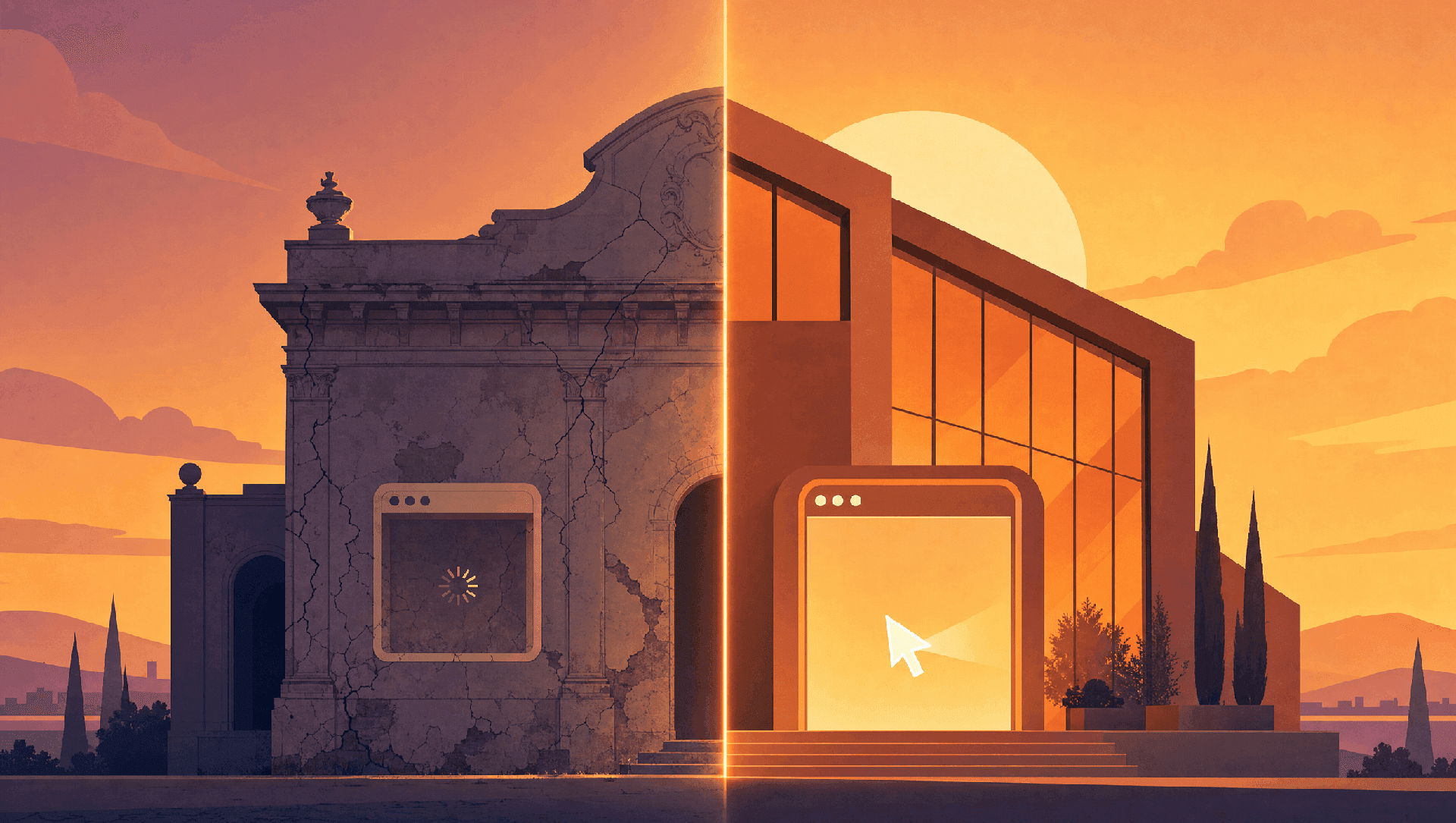
Design language moves fast, and visitors read "dated" as "out of business" or "behind the times". This is about more than vanity. Research widely cited across the industry holds that around 94% of first impressions of a website are design-related. Before anyone reads a word of your copy, the look of the site has already told them whether to take you seriously. Stock photos of headset-wearing call-centre staff and cluttered early-2020s layouts actively erode trust in 2026.
The cost: credibility, before you ever get a chance to make your case.
2. It's slow
Speed has stopped being a nicety and become a survival requirement. More than half of mobile visitors abandon a page that takes longer than three seconds to load, and Google's own research found the probability of a bounce rises sharply as load time climbs from one to three seconds. The practical benchmark in 2026 is a Largest Contentful Paint under about 2.5 seconds. Miss it and you lose visitors and rankings at once, because Core Web Vitals are a confirmed ranking signal.
The cost: rankings and visitors at the same time, which is the most expensive combination there is.
3. It breaks on a phone
Most web traffic is mobile, and Google indexes the mobile version of your site first. A site that looks fine on a laptop but has text too small to read and buttons too close to tap is penalised on both fronts, in rankings and in conversions. "Mobile-friendly" was the 2018 bar. The 2026 bar is mobile-first, designed for thumbs.
The cost: the larger half of your audience.
4. It gets traffic but no enquiries
This one fools people, because the traffic graph looks healthy. If visitors arrive and leave without calling, filling in a form or doing anything at all, your problem is conversion rather than visibility. Usually the site was built to look like a brochure rather than to guide a visitor toward an action: no clear next step, no phone number in the header, no obvious call to action. If a first-time visitor can't answer "what do I do now?" within a few seconds of landing, it is time to talk about a redesign.
The cost: leads you already paid to attract, walking straight back out.
5. The content describes a company you no longer are
Maybe you've added services, changed your pricing or shifted your whole positioning, and the site still describes the business you were three years ago. Outdated services, a team page full of people who have left, a newest testimonial dated 2021: each one suggests to a prospect that you might have closed down, and tells search engines your site is low priority. As one redesign guide notes, stale content is both a trust problem and an SEO one.
The cost: trust with people and relevance with Google, at the same time.
6. You can't change anything without phoning a developer
If updating a headline or publishing a blog post means emailing whoever built the site and waiting three days, your platform is the bottleneck. An out-of-date platform is also a security liability. A modern content system should let a non-technical person change copy, add a page or post an article without touching code. When the tool fights you, the site stops being maintained, and an unmaintained site ages fast.
The cost: your own time and momentum, and increasingly your security.
7. Your competitor's site quietly outclasses yours
Try an uncomfortable exercise: open your site and your three closest competitors' sites side by side, as a first-time customer would. If theirs are cleaner, faster or clearer, you are likely losing business before any sales conversation begins. Buyers in 2026 don't only compare you to direct rivals; they compare you to the best digital experience they had that week. Friction on a clunky site feels magnified when someone has just used a seamless one.
The cost: the deals decided before you even knew you were competing.
A redesign rebuilds the foundation, which is the point
A fair caveat: not every problem on this list needs a full rebuild. An isolated slow page, a broken link or an old photo can simply be fixed. When several signs cluster (poor mobile, slow across the board, no conversions, content that no longer reflects the business), you are looking at structural problems that patching won't solve. A proper redesign rebuilds the foundation for the search landscape and buyer expectations that exist now, rather than the ones that existed when the site launched. Done right, with redirects and structure preserved, it protects your rankings and usually improves them.
Most owners underrate the reason this matters: there is no neutral. Every prospect who lands on a slow, confusing or dated site forms a bad first impression in a context where you rarely get a second one. "Good enough" ends up costing more than a redesign.
At MalbarDesign we build websites as an extension of your brand identity rather than standalone brochures: fast, mobile-first, structured for conversion and made so you can actually manage them. If two or more of these signs made you wince, tell us about your site and we will tell you honestly whether it needs a refresh or a rebuild. (Once it is live, the next job is making sure people can find it. Here's why a beautiful website still gets no traffic.)
FAQ
Q: How do I know if my website needs a redesign?
Look for clustering warning signs: a dated look, slow load times, poor mobile experience, traffic that doesn't convert, content that no longer reflects your business, a platform you can't update yourself, and competitors whose sites clearly outclass yours. One isolated issue is a fix; two or more together usually mean a redesign.
Q: How often should a business redesign its website?
Most business websites need a significant redesign every three to four years, because design standards, technology and search algorithms change quickly. A site that looked modern in 2022 typically feels dated by 2026, though the real trigger is performance and relevance, not the calendar.
Q: Will a redesign hurt my Google rankings?
Not if it's done correctly. With proper 301 redirects, preserved URL structures and improved content and speed, a redesign usually protects rankings and often improves them, because a faster, better-structured, mobile-first site is exactly what Google rewards. Rankings suffer only when redirects and SEO basics are neglected during the move.
Q: My website gets traffic but no leads. Do I need a redesign?
Possibly, but that is a conversion problem, not a visibility one. People are finding you and leaving because there is no clear next step. A redesign focused on a clear path to action (obvious calls to action, visible contact options, a strong message above the fold) usually fixes it.
Q: How much does a website redesign cost?
It depends on scope, but a professional, conversion-focused redesign for a small to mid-size business is a meaningful investment rather than a cheap template swap. The more useful question is what a slow, dated or non-converting site is already costing you in lost leads every month, which is often far more than the redesign.
Sources
- Evolve Media: 7 Brutal Signs It's Time for a Website Redesign in 2026
- Digital Roots Media: 7 Signs Your Website Needs a Redesign
- Brantley Sites: Signs Your Website Needs a Redesign
- Tingalls: 5 Signs Your Website Needs a Redesign
- Weblumino: 15 Signs Your Website Needs a Redesign
FAQ
Questions people ask
How do I know if my website needs a redesign?
Look for clustering warning signs: a dated look, slow load times, poor mobile experience, traffic that doesn't convert, content that no longer reflects your business, a platform you can't update yourself, and competitors whose sites clearly outclass yours. One isolated issue is a fix; two or more together usually mean a redesign.
How often should a business redesign its website?
Most business websites need a significant redesign every three to four years, because design standards, technology and search algorithms change quickly. A site that looked modern in 2022 typically feels dated by 2026, though the real trigger is performance and relevance, not the calendar.
Will a redesign hurt my Google rankings?
Not if it's done correctly. With proper 301 redirects, preserved URL structures and improved content and speed, a redesign usually protects rankings and often improves them, because a faster, better-structured, mobile-first site is what Google rewards. Rankings suffer only when redirects and SEO basics are neglected.
My website gets traffic but no leads. Do I need a redesign?
Possibly, but that's a conversion problem, not a visibility one. People are finding you and leaving because there's no clear next step. A redesign focused on a clear path to action (obvious calls to action, visible contact options, a strong message above the fold) usually fixes it.
How much does a website redesign cost?
It depends on scope, but a professional, conversion-focused redesign is a meaningful investment rather than a cheap template swap. The more useful question is what a slow, dated or non-converting site is already costing you in lost leads each month, which is often far more than the redesign itself.
Need a website that supports the brand instead of fighting it?
Hand-coded HTML sites from €1,060 and WordPress or Joomla builds from €1,800, up to 10 pages.
Related articles
All articles Web
WebWill AI Agents Recommend Your Business? The New Trust Signals
73% of consumers now shop with AI agents. Agents don’t evaluate charisma; they evaluate data. The new trust signals, and the checklist to fix this month.
· 6 min read
 Web
WebEuropean Accessibility Act: What Your Website Must Do Now
The European Accessibility Act has applied since June 2025 and 2026 is the first full enforcement year. Who’s covered, what websites must do, what it costs to ignore.
· 5 min read
 Web
WebHow Much Does a Website Cost in 2026? Honest Numbers
From $200 DIY to $15,000 studio builds: how much a website costs in 2026, what moves the price, and the $1,100–5,000/year in costs nobody puts on the quote.
· 5 min read