Web
Website Redesign: When It’s Worth It (and Not)
Website redesign cost in 2026 ranges wildly. Here’s what drives the number, when a redesign pays for itself, and when a refresh is smarter.
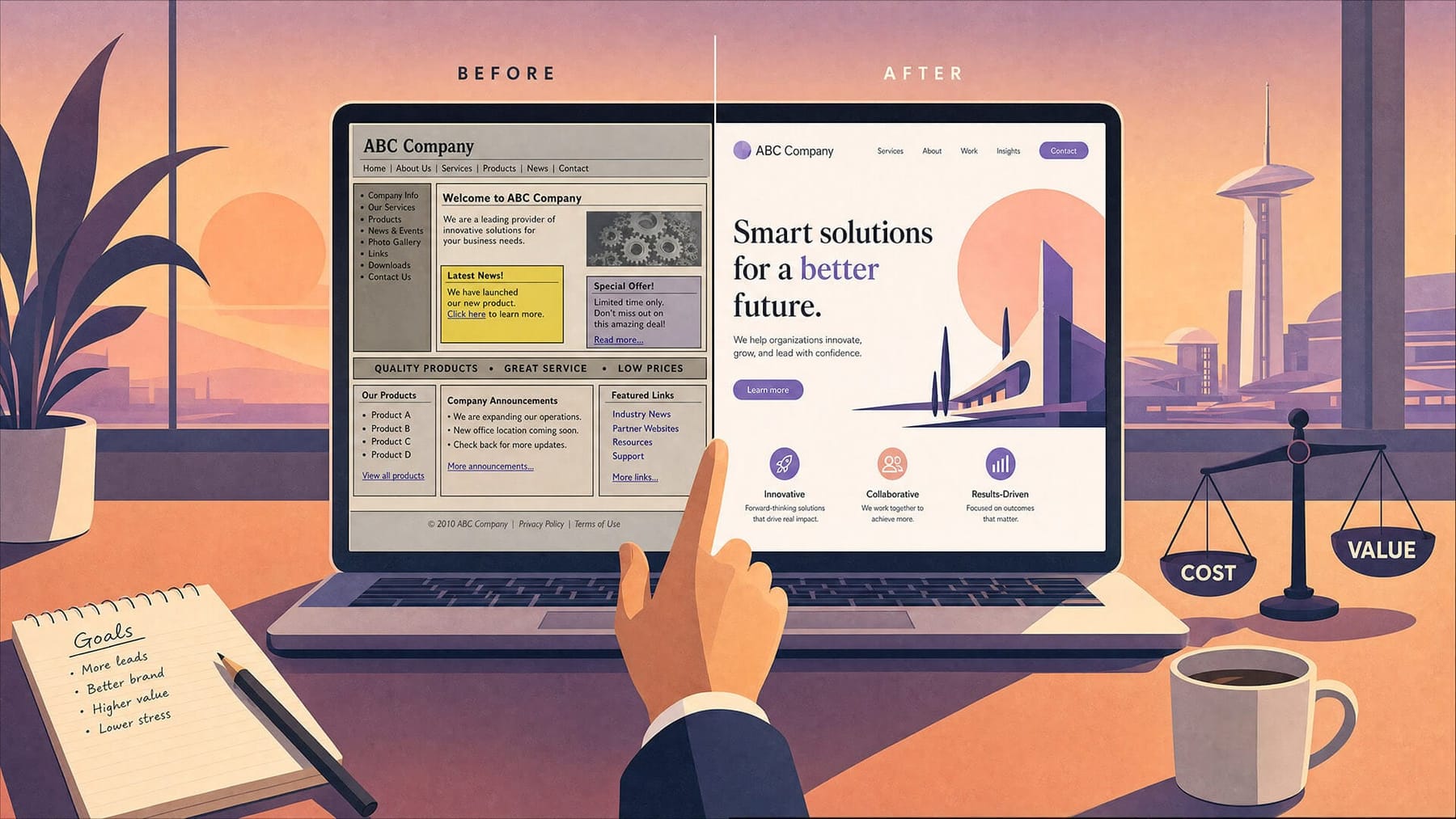
MalbarDesign creates original, functional webs for businesses that take their business seriously.
"Website redesign cost" is the first thing most owners type into Google, and it is the wrong place to start. We understand the instinct. Your site feels tired. A competitor's looks sharper. The leads have thinned. So before you decide anything, you want a number, which is fair. After three decades of redesigning sites, though, we can tell you that the number alone has misled more founders than it has helped. A better question than "what will a website redesign cost me?" is "what is my current site costing me right now?"
What a Website Redesign Cost Buys You in 2026
We'll give you the range first, because dodging it is a sales tactic we refuse to use. For a typical small-business site (five to fifteen pages on a modern CMS), a professional website redesign cost in 2026 generally lands between €3,000 and €15,000. That bracket buys strategy, custom design, development, content migration, basic SEO setup and launch support. Below it, you are usually in template-and-DIY territory. Above it, you move toward larger sites with custom features, integrations or e-commerce, where €15,000 to €40,000 and beyond is normal.
The spread is wide, and agencies aren't being evasive. The word "website" simply covers wildly different things. A five-page brochure site and a fifty-page site with booking and three languages are both "websites" in the way a bicycle and a lorry are both "vehicles."
Website Redesign Cost Drivers: What Moves the Number
So what decides where you land in that range? Five factors do most of the work.
Page count and templates
Every unique layout means design, development and testing. Ten pages built on four reusable templates therefore cost far less than ten bespoke ones.
Custom versus template design
A template is cheap and fast, and it looks like every other site that bought it. Custom design costs more, yet it is the only way to look unmistakably like you, which for a brand-led business is usually the entire point.
Content
New copy, photography and custom illustration add to the website redesign cost. They also add the most value. Design wrapped around placeholder text is just decoration.
SEO migration
This is the line nobody budgets for and everyone regrets skipping. Skip it, and your rankings can fall off a cliff overnight. More on that below, because it deserves its own warning.
Functionality
Forms, booking, multilingual setups and integrations: each one is a small project inside the project.
The Better Question: What Your Current Site Costs You
Now flip the lens. A website is not a brochure you print once. It is your hardest-working salesperson, on duty around the clock. So the real question is simple: is that salesperson helping you, or quietly turning people away?
Run the math on your own site. Take your monthly visitors, your conversion rate and the value of a single lead. Then model what one extra percentage point would be worth. For most businesses, the answer stings.
Consider the benchmark. Across fourteen industries, the average website converts at roughly 2.9%. Say yours sits at 1% while a good site in your sector reaches 2.5%. On a thousand visitors a month, that gap is fifteen lost leads, every month, on repeat. The website redesign cost is visible and one-time. The cost of the weak site is invisible and recurring. That is exactly why the bad site wins the argument by default, and bleeds you anyway.
So measure before you fixate on price. Treat a redesign as an investment to size correctly against what standing still already costs you, rather than as an expense to minimise.
Redesign or Refresh: Know the Difference Before You Spend
Money gets wasted here in both directions. People refresh when they need a redesign, and redesign when a refresh would do.
A refresh is repainting the walls: new colours, fresh images, tidier type, a few layout fixes. It keeps your structure and platform. It is right when the bones are sound and the site simply looks dated.
A redesign is renovating. You rethink structure, navigation, content and often the platform itself. It is right when the problems are structural rather than cosmetic.
Sometimes the real problem is the brand beneath the website. If your logo, colours and message no longer fit who you have become, a new site just paints over a confused identity. That is a different job. We have written separately about the signals that it is time to rebrand rather than redesign. Diagnose it correctly before you spend, and you will save the most money of all.
When You Should Not Pay for a Website Redesign
Agencies hungry for quotes won't write this section. Do not redesign if any of the following is true.
Your site is under three years old and structurally fine
Trends shift, but chasing every visual fashion is a tax rather than an investment. A refresh likely covers it. In practice, a major redesign earns its keep every three to five years, with light tuning in between, and not annually.
You have not diagnosed why it underperforms
"It feels old" describes a symptom without diagnosing it. Are you losing people to slow loading? Weak messaging? A clumsy mobile experience? An unclear offer? If you do not know, a redesign is just an expensive guess. So measure first.
You are about to change the business
If your positioning, services or audience are in flux, redesigning now means redesigning again in six months. Settle the strategy first. Then build the house.
You cannot feed it after launch
A beautiful new site with no one to update it decays fast. If that is your reality, spend less on the build and reserve budget for upkeep. A maintained good site beats an abandoned great one every time.
How to Spend a Website Redesign Budget Wisely
When the redesign is justified, protect the investment. Five rules keep your money working.
- Choose the partner on fit, not price. A €3,000 site that brings in real business beats a €500 site that just sits there. Equally, a €15,000 site sold by someone who never asked about your customers is just an expensive template. The same diligence we described for choosing a branding agency applies here.
- Insist on SEO migration in writing. Redirects, preserved URLs, migrated metadata. This is non-negotiable, and the data explains why. Without a proper redirect map, sites routinely lose 30–50% of organic traffic overnight. Only about one in ten migrations actually improves rankings. Do not become one of the nine.
- Pick the platform for your reality. WordPress, Joomla, or something else: the right answer depends on who maintains it and what it must do, not on what is fashionable this year.
- Budget for content, not just design. The prettiest layout fails with placeholder text. Real words and real images are where conversion actually lives.
- Define success up front. Conversion rate, lead volume, load time. Pick the numbers you will judge it by, and measure them before and after. Remember, too, that Core Web Vitals remain a confirmed Google ranking factor in 2026, so speed is more than a nice-to-have.
Website Redesign Cost: The Honest Bottom Line
A website redesign cost in 2026 is what a serious business tool costs: somewhere from a few thousand to many thousands, scaled to what you genuinely need. The price tag is only half the equation, and the less important half. The number that should drive your decision is what your current site is quietly costing you in leads that never convert. Work that out first. Then the website redesign cost question answers itself, sometimes with "not yet."
Want a straight answer on whether your site needs a redesign, a refresh or just a sharper strategy? Send it over and we will tell you honestly which one you actually need, even if the answer is "leave it alone for now."
FAQ
Q: How much does a website redesign cost in 2026?
For a typical small-business site (5–15 pages), a professional website redesign cost generally runs €3,000–€15,000, including strategy, design, development, content migration and basic SEO. Larger sites with custom functionality or e-commerce commonly reach €15,000–€40,000 or more.
Q: What is the difference between a website redesign and a refresh?
A refresh updates surface elements (colours, images, type, minor layout) while keeping the structure and platform. A redesign rethinks structure, content and often the platform itself. In short: a refresh fixes cosmetics; a redesign fixes foundations.
Q: How do I know if my website needs a redesign?
Look for structural problems: a poor mobile experience, slow loading, falling conversions, content you cannot update, or a site that no longer matches your brand. Cosmetic dissatisfaction alone usually calls for a refresh, not a full redesign.
Q: Will a redesign hurt my SEO?
It can, badly, if SEO migration is skipped. Preserving or redirecting URLs, migrating metadata and keeping content structure intact protects rankings. So insist on SEO migration being included in writing before you start.
Q: How often should a business redesign its website?
Plan a major redesign every three to five years, supported by smaller refreshes and continuous tuning in between. Redesigning more often usually chases fashion rather than fixing real problems.
Sources:
- Average conversion ~2.9% across 14 industries: Ruler Analytics study, summarised by CleverTap: https://clevertap.com/blog/average-website-conversion-rate-benchmarks/ (Additionally: global e-commerce average 2.5–3%, Triple Whale / IRP Commerce: https://www.triplewhale.com/blog/what-is-a-good-conversion-rate
- Loss of 30–50% of organic traffic after a poor migration: SEO Power Plays: https://seopowerplays.com/seo-migration-strategy/ (Additionally: case studies of 20–70% drops: https://ignitevisibility.com/why-changing-urls-can-devastate-seo-traffic/
- Only ~1 in 10 migrations improves rankings: Numen Technology: https://www.numentechnology.co.uk/blog/website-migration-seo-strategy
- Core Web Vitals = confirmed ranking factor (2026): Kreativa Group: https://www.kreativagroup.com/post/how-to-preserve-seo-during-a-website-redesign
FAQ
Questions people ask
How much does a website redesign cost in 2026?
For a typical small-business site (5–15 pages) a professional redesign generally costs €3,000–€15,000, including strategy, design, development, content migration and basic SEO. Larger sites with custom functionality commonly run €15,000–€40,000 or more.
What's the difference between a website redesign and a refresh?
A refresh updates surface elements while keeping the structure and platform. A redesign rethinks structure, content and often the platform itself. Refresh fixes cosmetics; redesign fixes foundations.
How do I know if my website needs a redesign?
Look for structural problems: poor mobile experience, slow loading, declining conversions, difficulty updating, or a site that no longer matches your brand. Cosmetic dissatisfaction alone usually calls for a refresh.
Will a redesign hurt my SEO?
It can if SEO migration is skipped. Preserving or redirecting URLs, migrating metadata and keeping content structure intact protects rankings. Insist on SEO migration in writing before you start.
How often should a business redesign its website?
A major redesign every three to five years, supported by smaller refreshes and continuous optimization in between. More often is usually chasing fashion rather than fixing real problems.
Need a website that supports the brand instead of fighting it?
Hand-coded HTML sites from €1,060 and WordPress or Joomla builds from €1,800, up to 10 pages.
Related articles
All articles Web
WebWill AI Agents Recommend Your Business? The New Trust Signals
73% of consumers now shop with AI agents. Agents don’t evaluate charisma; they evaluate data. The new trust signals, and the checklist to fix this month.
· 6 min read
 Web
WebGenerative Engine Optimization: How to Get Recommended by AI
Buyers now ask AI and get an answer, not a list. Generative engine optimization is how your business becomes that answer: the rules, the data, the playbook.
· 6 min read
 Brand
BrandWhy Your Beautiful Website Gets No Traffic (and How to Fix It)
A stunning website nobody visits has a discoverability problem, not a design one. Why your website is not getting traffic in 2026, and the fixes, in order.
· 6 min read