Logo
Logo Refresh vs Rebrand: Which One Does Your Business Need?
One keeps everything you’ve earned; the other bets it. Logo refresh vs rebrand: what each really is, the 5-question decision test, and the refresh-first economics.
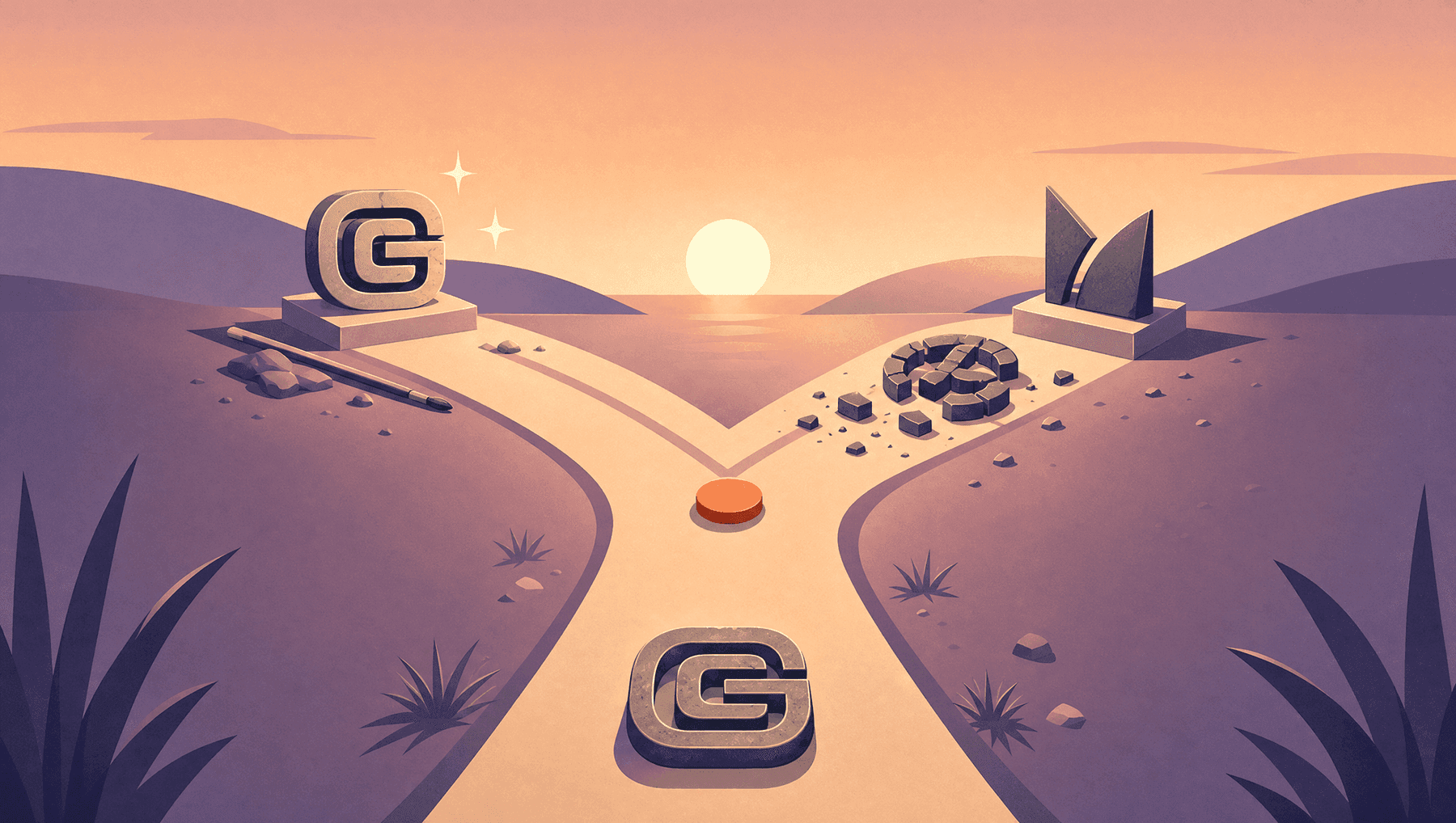
One costs a few hundred euros and keeps everything you’ve earned. The other costs ten times more and bets the recognition you’ve built. Most businesses choose wrong, and they do it in both directions.
The question reaches our inbox every week in one form or another: our logo feels dated, do we need a new one? The honest answer is that “new logo” describes two completely different projects with different price tags, risks and payoffs. Mixing them up is how businesses either overpay for a revolution they didn’t need, or keep polishing a mark that should have been retired long ago.
So we will separate them properly.
What a logo refresh actually is
A logo refresh keeps your mark’s core idea and fixes its execution: cleaned-up typography, corrected spacing and proportions, a simplified shape that survives small sizes, a disciplined color cleanup and, critically, a proper system around it (variants, clear space, files that work everywhere). The recognition you’ve spent years buying stays. The embarrassment goes.
Think of the great quiet refreshes. The world’s biggest brands redraw their marks every few years and most customers never consciously notice, which is exactly the point. A good refresh is surgery so clean it looks like nothing happened.
A refresh is right when the mark has real equity (customers recognize it), the core idea still matches what you do, and the problem is craft: dated fonts, muddy details, no consistency, files that fall apart on a trade-fair banner. Typical investment: hundreds of euros rather than thousands, and weeks rather than months. (Our Logo Refresh package covers exactly this scope, from €175.)
What a rebrand actually is
A rebrand replaces the strategy as well as the artwork: new positioning, often a new name or architecture, a new verbal identity, and a new visual system built from a new idea. It’s the right tool when the business itself has changed shape (new market, new offer, merged companies, a reputation to leave behind) and the old mark now says something untrue.
A rebrand is a bet: you spend the recognition you’ve built to buy a position you need. Sometimes that’s exactly right. But it fails predictably when it’s done for the wrong reasons, such as boredom, a new marketing hire’s itch or imitating a competitor. That is why so many rebrands fail: they solve an internal feeling instead of a market problem.
The decision test: five questions
- Do customers recognize your current mark? Yes → lean refresh. No equity to preserve → rebrand costs less than you fear.
- Has your positioning changed? Same business, better executed → refresh. Different promise, market, or name → rebrand.
- What exactly embarrasses you? If you can point at details (font, colors, fuzzy files) → refresh. If the whole idea feels wrong → rebrand.
- What’s the trigger? Growth outrunning your look usually wants a refresh-plus-system. Strategic repositioning wants a rebrand.
- What can you actually fund properly? An underfunded rebrand is worse than a disciplined refresh. Half-rebrands leave you with two identities and zero clarity.
Score it honestly and the answer usually becomes obvious. When in doubt, refresh first. It’s reversible and cheap, and it often shows whether a deeper rebrand is truly needed or whether your “brand problem” was an execution problem all along.
The refresh-first economics
Sellers of big rebrands rarely show this math. A refresh recovers most of the perceived-quality gap at perhaps a tenth of a rebrand’s cost, in a fraction of the time, with near-zero recognition risk. For a growth-stage company whose quality is ahead of its image, that’s usually the highest-ROI design money available. If strategy shifts later, you rebrand from a position of visual order rather than chaos, and the rebrand itself gets cheaper because half the system thinking is already done.
We do both: a disciplined Logo Refresh when your mark deserves to live, and a full Brand Identity when it doesn’t. The free check below tells you which, honestly.
Sources
- MalbarDesign: 7 Signs You’ve Outgrown Your Brand: https://malbardesign.com/how-to-know-when-youve-outgrown-your-brand/
- MalbarDesign: Why Rebrands Fail: https://malbardesign.com/the-real-reason-rebrands-fail-and-what-to-do-instead/
- MalbarDesign: How Much Does a Logo Cost: https://malbardesign.com/logo-design-cost-pricing-guide/
FAQ
Questions people ask
What’s the difference between a logo refresh and a rebrand?
A refresh keeps the mark’s core idea and fixes execution (typography, proportions, color, simplification, a proper file system) while preserving recognition. A rebrand replaces the strategy: new positioning, often a new name, a new visual and verbal system. Different projects, different budgets, different risks.
How much does a logo refresh cost compared to a rebrand?
A professional refresh typically costs hundreds of euros and takes weeks; a full rebrand with strategy, identity system and rollout typically costs thousands to tens of thousands and takes months. The refresh preserves brand equity; a rebrand spends it to buy a new position.
When is a logo refresh enough?
When customers recognize your mark, your positioning hasn’t fundamentally changed, and the embarrassment is in details: dated fonts, weak small-size performance, inconsistent files. That’s craft rather than strategy, and a refresh fixes it.
When do I need a full rebrand?
When the business itself changed shape: new market or offer, a merger, a name that no longer fits, a reputation to leave behind, or positioning your current identity actively contradicts.
Is it risky to refresh instead of rebrand?
It’s the lower-risk move: reversible, cheap, and recognition-preserving. The bigger risk runs the other way, in panic rebrands that spend years of earned recognition to solve an internal feeling rather than a market problem.
Need a logo that holds up in print, on screen and in ten years?
Fixed prices, 4 concepts, vector files and a money-back guarantee on the first concepts.
Related articles
All articles Brand
BrandQuiet Confidence or Dopamine Design? 2026 Trend Test
2026’s web trends split in two: neon dopamine design and quiet, grain-textured restraint. Which fits your brand depends on the decision your buyer is making
· 4 min read
 Brand
BrandHow to Launch a Rebrand Without Losing Your Customers
The files are delivered, and now comes the part that decides everything: the switch. The 215-asset inventory, the bridge period, the inside-out sequence, and the 30-day scoreboard.
· 3 min read
 Brand
BrandWhy 2 Logo Directions Beat 10 Concepts, Every Time
“How many concepts do I get?” is the most revealing question in logo design. Why high concept counts signal uncertainty, and what a decision-led process looks like
· 3 min read