Brand
How to Name a Brand (Without Regret)
Naming is the most underrated decision in branding, and the hardest to undo. A practical framework, the traps to avoid, and how to check a name is free.
MalbarDesign creates original, strategic logos for businesses that take their brand seriously.
Knowing how to name a brand is the most underrated skill in the whole of branding, and the name is the decision that’s hardest to take back. A logo can be redrawn, a color palette swapped, a website rebuilt. The name, though, is woven into your domain, your email, your legal documents, your customers’ memories and the way people say you out loud. Get it wrong and you can’t simply tweak it later. You either carry it or take on the costly, confusing business of changing what people already call you. And yet most founders spend weeks agonizing over a logo and an afternoon picking the name. The proportions are exactly backwards.
We’ve watched naming go both ways. We’ve seen a sharp, ownable name give a tiny company the presence of a much larger one, and we’ve watched a clever-but-confusing name quietly tax a business every single day: misheard on the phone, misspelled in searches, impossible to find. The good news is that naming, while never purely mechanical, follows principles. Below is the framework we use with clients, the traps that kill otherwise good names, and how to check a name is actually free before you fall in love with it.
What a Brand Name Actually Has to Do
Before generating a single option, get clear on the job. A brand name doesn’t need to describe everything you do. Its job is to be a memorable, ownable handle that your reputation can attach to over time. Amazon doesn’t mean “online shop.” Apple doesn’t mean “computers.” The brand pours the meaning into the name; the name only has to be a good container.
A strong name generally clears a few practical bars: it’s easy to say and spell after hearing it once; it’s distinctive enough to find and own; it works in the contexts you’ll actually use it (spoken aloud, in a URL, on a logo); and it leaves room to grow rather than boxing you into today’s single product. Notice “descriptive” isn’t on that list. Descriptiveness feels safe and is usually a trap, as the section on traps explains.
A Practical Naming Framework
Naming feels like magic from the outside and is mostly disciplined exploration from the inside. The process:
1. Define the brief first. What does this brand stand for, who’s it for, what feeling should the name carry, and what must it not feel like? A name is a downstream decision from positioning, which is exactly why a proper brief matters as much here as it does for a logo. Name into a clear brief and the field narrows productively.
2. Choose a naming territory. Names broadly fall into types, and picking your territory before brainstorming stops you comparing apples to oranges:
- Descriptive (says what you do): clear but generic and hard to own.
- Suggestive (evokes a quality): often the sweet spot; think of a name that hints at speed, trust or craft without spelling it out.
- Abstract/invented (a coined word): maximally ownable, but needs investment to build meaning.
- Founder/place: personal and credible, with provenance, but can limit scale or sale later.
3. Generate widely, judge later. Produce far more options than feels reasonable (a hundred is not too many) without filtering. Keep generating and judging apart; killing ideas while creating them strangles the good ones in the cradle.
4. Pressure-test the shortlist. For each survivor, say it on an imaginary phone call. Type it as a URL. Put it in a sentence next to a competitor. Imagine it on a sign, in an app icon, shouted across a trade-fair hall. Names that look fine on a slide often collapse in the mouth or the address bar.
5. Check it’s free before you fall in love. This is the single most painful naming mistake, and it gets its own section below.
The Five Traps That Kill Good Names
After enough naming projects, the same failure modes recur.
Trap 1: Too descriptive. “Prague Web Solutions” tells people what you do and guarantees you’ll vanish among a dozen near-identical names, impossible to own or trademark. Descriptive feels safe, yet it’s the riskiest territory for distinctiveness.
Trap 2: Too clever. Names that require explaining (intentional misspellings, buried puns, in-jokes) fail the phone test. If you have to spell it every time you say it, the friction is costing you customers, and nobody awards points for wit.
Trap 3: Too narrow. “Petr’s Custom Phone Cases” is a fine name until you add laptop sleeves. Naming for today’s single product is one of the signals you’ll outgrow your brand sooner than you’d like. Leave headroom.
Trap 4: Trend-chasing. Dropping vowels, tacking on “-ly” or “-ify,” borrowing whatever suffix is hot this year. It dates fast and lands you in a crowd of lookalikes. A name should outlive a trend cycle.
Trap 5: Falling in love before checking. The most expensive trap, because it makes you ignore the others. You commit emotionally, then discover the domain’s taken or the name’s trademarked, and now you’re rationalizing a name you can’t actually have.
How to Check a Name Is Actually Free
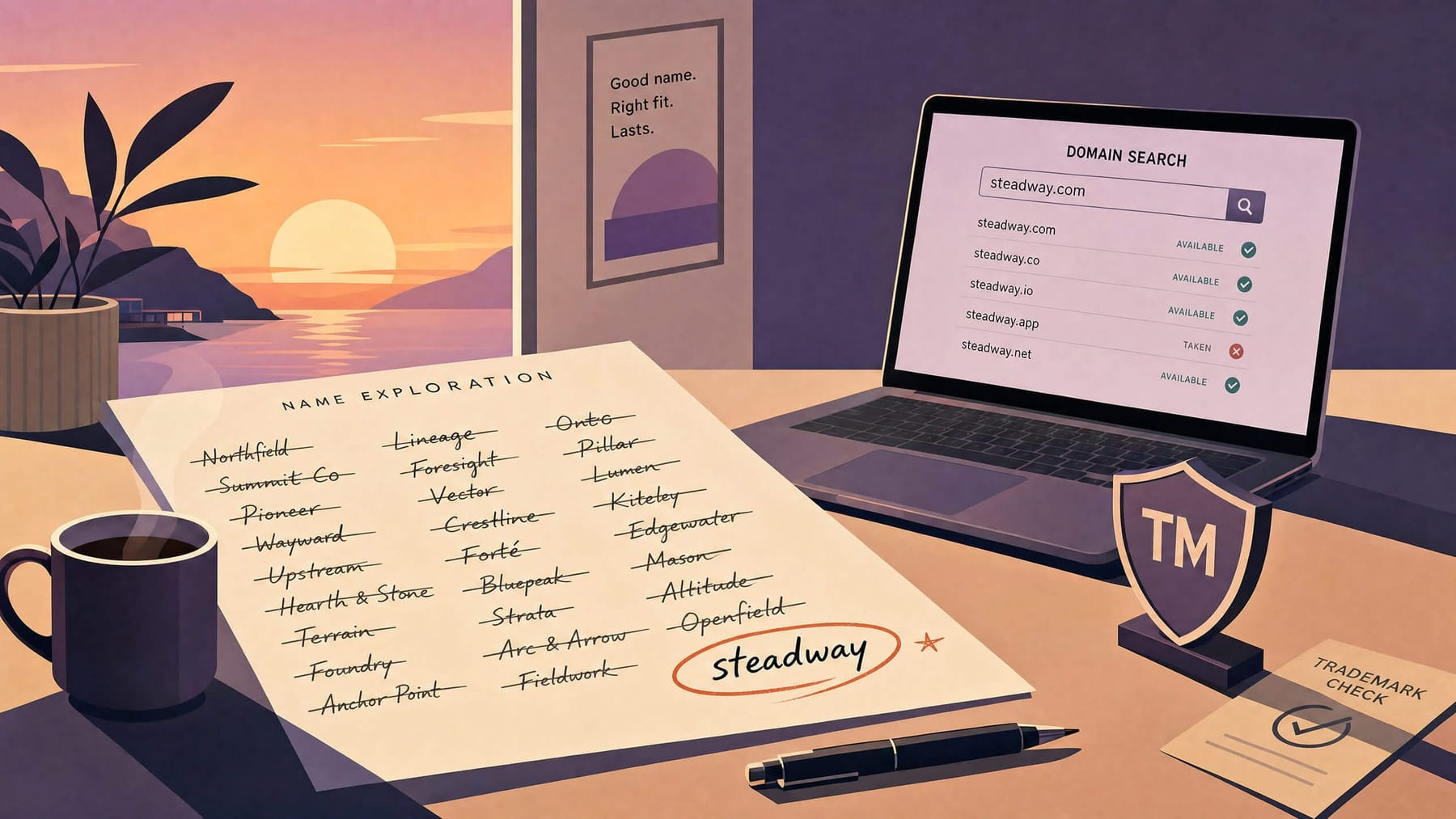
Before committing, run every shortlisted name through these checks. Do this before attachment forms, not after:
- Domain. Is a workable domain available? You don’t need the exact
.com, but you need something clean and credible. A name whose only available domain is hyphenated and awkward is a name fighting you forever. - Trademark. Search the relevant trademark registers for your country and markets (in the EU, the EUIPO database; nationally, your local office). This isn’t legal advice and a lawyer should confirm, but an obvious clash you find in five minutes saves an expensive surprise later.
- Search results. Google it. If page one is crowded with an established company, especially in a related field, you’ll spend years fighting to be found. A name you can’t rank for is a name working against your visibility.
- Social handles. Check the platforms you’ll actually use. Exact matches are a bonus, not a requirement, but wildly inconsistent handles fragment your presence.
- Say it in other languages. If you sell across borders, make sure it doesn’t mean something unfortunate elsewhere. This one has humbled some very large companies.
A name that clears all five is rare and worth holding onto. A name that fails one or two can still work with compromise. A name that fails three or more, however much you love it, is telling you something.
Naming Is the Foundation, Not the Finish
The name is where the brand begins, and it is only the beginning. The most ownable name in the world still needs an identity built around it: a logo, a voice, a visual system that pours meaning into the container. “Apple” only means what it means because of decades of deliberate brand-building on top of it. So choose a name that’s a good vessel, then do the work of filling it through real identity design.
Give this decision the time it deserves, which is far more than an afternoon. Get the name right and everything downstream gets easier. Get it wrong and you’ll feel the friction in every phone call, search and spelled-out email address for as long as the business exists.
If you’re naming a new brand, or you’re stuck with one that’s quietly working against you, get in touch. Naming is where we start every identity, and a second pair of eyes early saves an expensive change later.
FAQ
Q: How do I name a brand?
Start from a clear brief (positioning, audience, desired feeling), choose a naming territory (descriptive, suggestive, abstract, or founder/place), generate many options without judging, pressure-test the shortlist out loud and as a URL, then verify the name is legally and digitally free before committing.
Q: Why is naming so important in branding?
Because the name is the hardest element to change later. It’s embedded in your domain, email, legal documents and customers’ memories. A logo can be redrawn easily; a name change means re-teaching everyone what to call you, at significant cost.
Q: What makes a good brand name?
A good name is easy to say and spell after hearing it once, distinctive enough to own and find, works spoken and as a domain and logo, and leaves room to grow beyond today’s product. Notably, it does not need to describe what you do.
Q: Should a brand name describe what the company does?
Usually no. Descriptive names feel safe but are generic, hard to own and hard to trademark. Suggestive names that evoke a quality, or distinctive coined names, are typically stronger because they can be owned and grown into.
Q: How do I check if a brand name is available?
Check domain availability, search the relevant trademark registers (EUIPO in the EU, plus your national office), Google the name for crowded results, check social handles, and confirm it doesn’t mean something unfortunate in other languages. Confirm trademarks with a lawyer.
FAQ
Questions people ask
How do I name a brand?
Start from a clear brief, choose a naming territory (descriptive, suggestive, abstract, or founder/place), generate many options without judging, pressure-test the shortlist out loud and as a URL, then verify the name is legally and digitally free before committing.
What makes a good brand name?
Easy to say and spell after hearing once, distinctive enough to own and find, works spoken and as a domain and logo, and leaves room to grow beyond today's product. It does not need to describe what you do.
Should a brand name describe what the company does?
Usually no. Descriptive names feel safe but are generic, hard to own and trademark. Suggestive names that evoke a quality, or distinctive coined names, are typically stronger because they can be owned and grown into.
How do I check if a brand name is available?
Check domain availability, search trademark registers (EUIPO in the EU plus your national office), Google for crowded results, check social handles, and confirm it doesn't mean something unfortunate in other languages. Confirm trademarks with a lawyer.
Why is naming so important in branding?
Because the name is the hardest element to change later, embedded in your domain, email, legal documents and customers' memories. A logo can be redrawn easily; a name change means re-teaching everyone what to call you, at significant cost.
Not sure whether your brand needs a refresh or a rebuild?
Ask for the free 5-point brand check: concrete recommendations for your logo and website within 48 hours, no sales call unless you want one.
Related articles
All articles Brand
BrandFounder Brand or Company Brand? Why LinkedIn Changed the Answer
Personal LinkedIn profiles now out-engage company pages by up to 8x. Why the algorithm changed, what it means for B2B founders, and where to post what.
· 5 min read
 Brand
BrandHow to Launch a Rebrand Without Losing Your Customers
The files are delivered, and now comes the part that decides everything: the switch. The 215-asset inventory, the bridge period, the inside-out sequence, and the 30-day scoreboard.
· 4 min read
 Brand
BrandThe DIY Brand Audit: Score Your Brand in One Afternoon
Before spending a euro on design, spend an afternoon on diagnosis. The exact 5-test brand audit we run professionally, simplified for coffee, honesty, and one stranger.
· 4 min read